
Against a backdrop of change and volatility, organisations are trying to build their workforces for the future but without the evidence they really need. As organisations align workforce strategy with evolving business needs, the quality of talent decisions is critical. However, assessment has remained stuck with legacy methods such as CVs, interviews and traditional psychometrics. And increasing disruption due to Gen AI has been drowning out the signal.
In this article, we explore how using the latest technologies combined with rigorous assessment science, we can deploy immersive talent simulations – at scale – providing organisations with high-signal, work-relevant data to inform confident talent decisions.
Building for the future, without the evidence to get there
Over 70% of CEOs rank developing and retaining talent as a critical risk for executing successfully on their strategy (KPMG, 2025; McKinsey, 2025). In order to adapt and thrive, organisations need the right skills in the business. As a result, skills are central to workforce planning, shaping decisions about hiring, development, internal mobility and leadership pipelines.
The teams closest to this agenda - talent acquisition, talent management and L&D - are expected to turn future-focused skills strategies into real decisions: who to hire, who to develop, where to invest. All while balancing speed, fairness and defensibility in high-stakes contexts.
But organisations are relying on data that gives only a weak and indirect signal on talent, operating without reliable, scalable evidence of real capability. The ambition to build more effective and adaptable organisations is clear. But this is nothing without access to higher quality, relevant evidence to make those talent decisions with confidence.
The result is a growing execution gap between strategic ambition on the one hand, and operational reality on the other. Rather than build the adaptability, focus and momentum organisations need, there is a risk that skills-based transformation remains an expensive aspiration that fails to cut through to real business impact. Many organisations hence find themselves building for the future, without the evidence to get there. We need to transform assessment to close this critical gap.
Market Disruption
The world of talent is facing disruption on an unprecedented scale, driven by the rapidly changing world of work and widespread adoption of AI by candidates. The emergence of Gen AI and fast-paced technological development more widely are rapidly impacting what tasks can be done by machine, what is best done by humans and how the two interact. Consequently, the tasks and skills needed for success are evolving at pace with service industries and professional roles particularly impacted.
For example, research by Dell/Institute for the Future estimated that more than half of the jobs we will have in the next decade have not yet been invented. Closing skills gaps is a growing focus for many organisations, in large part as a response to this uncertainty. This research illustrates without doubt that we are experiencing rapid change to the nature of work itself.
Alongside this, there has been a surge in applicant numbers, driven in part by candidates using AI to ease the burden of making job applications. This has left many hiring teams swamped with more applicants than they can handle. For example, ISE data from the UK indicates that from 2024 to 2025, there was a 59% increase in application numbers, Meanwhile, the number of graduate-level early careers vacancies has tightened significantly.
This context has also been driving an integrity problem for traditional assessment. As well as leveraging Gen AI to put in more applications, many candidates are also using it to help overcome assessment hurdles. Somewhere between 8% (Bright Network) to 28% (Capterra) of candidates admit to using AI to also help complete assessments, with text-based formats like verbal reasoning or situational questions particularly vulnerable. As a result, a significant subset of candidates is leapfrogging ahead of the pack based not on capability but guile. This presents not only a moral issue for employers, but a deeply practical one if they can no longer confidently differentiate the real high performers.
Technology and work have evolved. Assessment hasn't.
This disruption presents a once-in-a-generation challenge for assessment. For decades, assessment has relied heavily on self-report methods, such as CVs and interview, and unreliable performance measures. These methods are often removed from the reality of work, measuring only what people say they can do. But they lack the depth and relevance needed to support confident talent decisions.
Assessment has a signal problem.
Organisations need to get a grip on closing the gap between understanding what they need to succeed, and accurately aligning their people with their rapidly evolving business challenges. For too long, talent teams have had to rely on low signal/high noise sources of information, all of which have significant limitations:
As a result, there is an increasingly low signal from these tools and a lot more noise. Organisations are left blind to real capability, just as the stakes of talent decisions get higher. What was once an accepted limitation has now become a problem which can no longer be ignored.
Achieving high signal assessment for the many, not the few
The biggest challenge facing organisations in this regard is to have high signal, relevant data about talent at scale. This is where innovation is critical.
Simulation of real work has been used effectively in certain focused roles for many years. Take the example of flying in an airliner. Would you rather fly on that plane knowing the pilot had repeatedly landed successfully in the simulator, without crashing the aircraft. Or would you be happy to rely on an interview where they ‘came across well’, said ‘what we wanted to hear’, and sounded like they would ‘fit right in’ with the team?
As an industry, we have long known that one of the most valid ways to assess capability is through realistic tasks and simulations, observing what people can actually do in contexts that mirror the job. This is regularly delivered using multi-method assessment or development centres, combining multiple realistic tasks to give a rounded view of capability and role fit. However, running high-quality simulations like this has historically been too expensive, too labour-intensive and too difficult to scale. For this reason, they have remained the costly preserve of early careers hiring programmes or leadership development centres for the few.
The assessment industry has instead defaulted to methods that are easier to deploy, even when they are more biased or weaker predictors of performance. But to move forward to high signal insight so organisations can make talent decisions with much greater confidence, the point here is clear. We need to measure what people can do, not just rely on what they say they can do.
Immersive simulations at scale
Making this step change requires a unique combination of experience, relevance and scalability. How can we deliver high-quality simulation, cost-effectively at scale across the organisation?
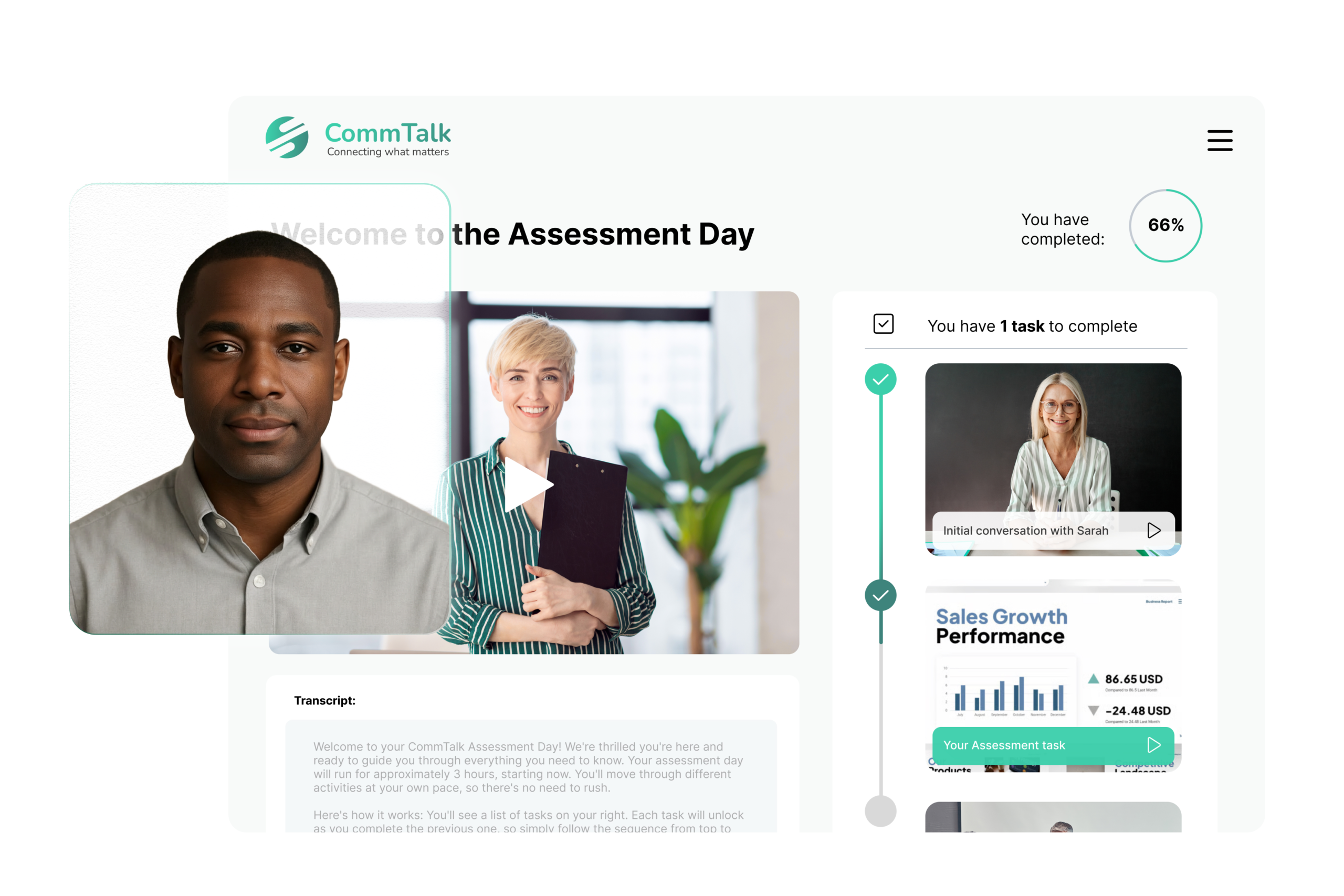
The Symulate platform has been designed to solve exactly this challenge, built on the foundations of contextualised, realistic simulations to measure the actual tasks that matter; Immersive interactions to transform the candidate experience; and ensuring fair and defensible decision-making.
Key to this is delivering realistic, real-time task simulations that are fully relevant to the context of the organisation and role, involving visually engaging, natural and interactive personas to directly assess the skills that matter for high-stakes hiring and development decisions. Rather than being limited to LLM chat, this lifts the candidate experience to a whole new level of visual realism and immersion.
Moving from experience to intelligence then rests on combining the latest assessment science with AI-powered simulation technology, to assess real capability with new depth. Combining AI-supported analysis with human-in-the-loop decision-making is critical to ensure decisions are transparent, explainable and defensible.
All of this makes what was previously impractical, now entirely feasible. Organisations no longer have to choose between depth and scale, realism and efficiency, or rigour and candidate experience. Instead of relying on indirect signals, organisations can directly see how people actually perform work-relevant tasks. This provides higher-quality evidence and better outcomes: talent decisions are more predictive, more defensible and better aligned to the organisation. The candidate experience finally reflects the reality of the work itself, whilst doing so cost-efficiently with much greater reach.