
Resources
Against a backdrop of change and volatility, organisations are trying to build their workforces for the future but without the evidence they really need. As organisations align workforce strategy with evolving business needs, the quality of talent decisions is critical. However, assessment has remained stuck with legacy methods such as CVs, interviews and traditional psychometrics. And increasing disruption due to Gen AI has been drowning out the signal.
In this article, we explore how using the latest technologies combined with rigorous assessment science, we can deploy immersive talent simulations – at scale – providing organisations with high-signal, work-relevant data to inform confident talent decisions.
Building for the future, without the evidence to get there
Over 70% of CEOs rank developing and retaining talent as a critical risk for executing successfully on their strategy (KPMG, 2025; McKinsey, 2025). In order to adapt and thrive, organisations need the right skills in the business. As a result, skills are central to workforce planning, shaping decisions about hiring, development, internal mobility and leadership pipelines.
The teams closest to this agenda - talent acquisition, talent management and L&D - are expected to turn future-focused skills strategies into real decisions: who to hire, who to develop, where to invest. All while balancing speed, fairness and defensibility in high-stakes contexts.
But organisations are relying on data that gives only a weak and indirect signal on talent, operating without reliable, scalable evidence of real capability. The ambition to build more effective and adaptable organisations is clear. But this is nothing without access to higher quality, relevant evidence to make those talent decisions with confidence.
The result is a growing execution gap between strategic ambition on the one hand, and operational reality on the other. Rather than build the adaptability, focus and momentum organisations need, there is a risk that skills-based transformation remains an expensive aspiration that fails to cut through to real business impact. Many organisations hence find themselves building for the future, without the evidence to get there. We need to transform assessment to close this critical gap.
Market Disruption
The world of talent is facing disruption on an unprecedented scale, driven by the rapidly changing world of work and widespread adoption of AI by candidates. The emergence of Gen AI and fast-paced technological development more widely are rapidly impacting what tasks can be done by machine, what is best done by humans and how the two interact. Consequently, the tasks and skills needed for success are evolving at pace with service industries and professional roles particularly impacted.
For example, research by Dell/Institute for the Future estimated that more than half of the jobs we will have in the next decade have not yet been invented. Closing skills gaps is a growing focus for many organisations, in large part as a response to this uncertainty. This research illustrates without doubt that we are experiencing rapid change to the nature of work itself.
Alongside this, there has been a surge in applicant numbers, driven in part by candidates using AI to ease the burden of making job applications. This has left many hiring teams swamped with more applicants than they can handle. For example, ISE data from the UK indicates that from 2024 to 2025, there was a 59% increase in application numbers, Meanwhile, the number of graduate-level early careers vacancies has tightened significantly.
This context has also been driving an integrity problem for traditional assessment. As well as leveraging Gen AI to put in more applications, many candidates are also using it to help overcome assessment hurdles. Somewhere between 8% (Bright Network) to 28% (Capterra) of candidates admit to using AI to also help complete assessments, with text-based formats like verbal reasoning or situational questions particularly vulnerable. As a result, a significant subset of candidates is leapfrogging ahead of the pack based not on capability but guile. This presents not only a moral issue for employers, but a deeply practical one if they can no longer confidently differentiate the real high performers.
Technology and work have evolved. Assessment hasn't.
This disruption presents a once-in-a-generation challenge for assessment. For decades, assessment has relied heavily on self-report methods, such as CVs and interview, and unreliable performance measures. These methods are often removed from the reality of work, measuring only what people say they can do. But they lack the depth and relevance needed to support confident talent decisions.
Assessment has a signal problem.
Organisations need to get a grip on closing the gap between understanding what they need to succeed, and accurately aligning their people with their rapidly evolving business challenges. For too long, talent teams have had to rely on low signal/high noise sources of information, all of which have significant limitations:
As a result, there is an increasingly low signal from these tools and a lot more noise. Organisations are left blind to real capability, just as the stakes of talent decisions get higher. What was once an accepted limitation has now become a problem which can no longer be ignored.
Achieving high signal assessment for the many, not the few
The biggest challenge facing organisations in this regard is to have high signal, relevant data about talent at scale. This is where innovation is critical.
Simulation of real work has been used effectively in certain focused roles for many years. Take the example of flying in an airliner. Would you rather fly on that plane knowing the pilot had repeatedly landed successfully in the simulator, without crashing the aircraft. Or would you be happy to rely on an interview where they ‘came across well’, said ‘what we wanted to hear’, and sounded like they would ‘fit right in’ with the team?
As an industry, we have long known that one of the most valid ways to assess capability is through realistic tasks and simulations, observing what people can actually do in contexts that mirror the job. This is regularly delivered using multi-method assessment or development centres, combining multiple realistic tasks to give a rounded view of capability and role fit. However, running high-quality simulations like this has historically been too expensive, too labour-intensive and too difficult to scale. For this reason, they have remained the costly preserve of early careers hiring programmes or leadership development centres for the few.
The assessment industry has instead defaulted to methods that are easier to deploy, even when they are more biased or weaker predictors of performance. But to move forward to high signal insight so organisations can make talent decisions with much greater confidence, the point here is clear. We need to measure what people can do, not just rely on what they say they can do.
Immersive simulations at scale
Making this step change requires a unique combination of experience, relevance and scalability. How can we deliver high-quality simulation, cost-effectively at scale across the organisation?
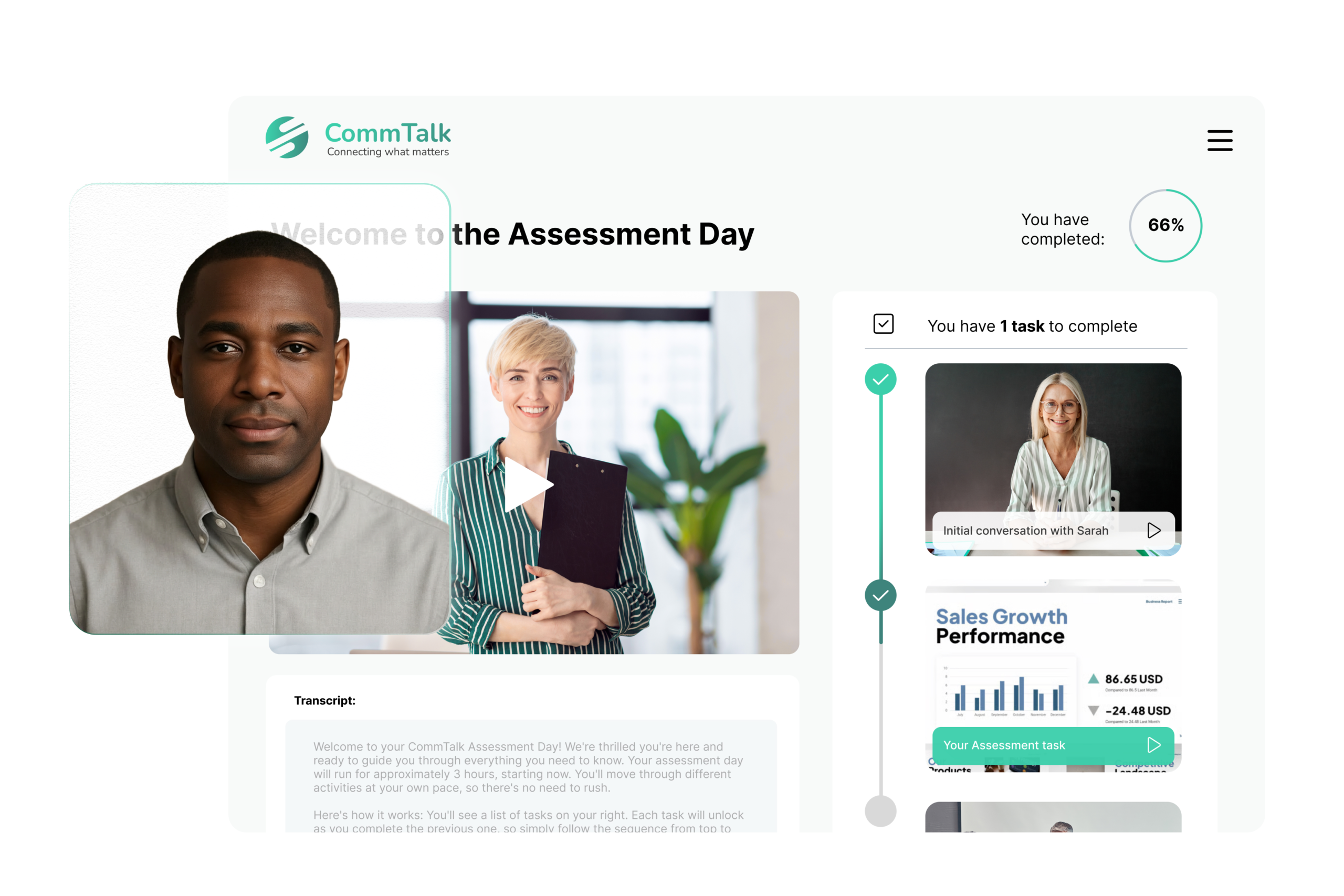
The Symulate platform has been designed to solve exactly this challenge, built on the foundations of contextualised, realistic simulations to measure the actual tasks that matter; Immersive interactions to transform the candidate experience; and ensuring fair and defensible decision-making.
Key to this is delivering realistic, real-time task simulations that are fully relevant to the context of the organisation and role, involving visually engaging, natural and interactive personas to directly assess the skills that matter for high-stakes hiring and development decisions. Rather than being limited to LLM chat, this lifts the candidate experience to a whole new level of visual realism and immersion.
Moving from experience to intelligence then rests on combining the latest assessment science with AI-powered simulation technology, to assess real capability with new depth. Combining AI-supported analysis with human-in-the-loop decision-making is critical to ensure decisions are transparent, explainable and defensible.
All of this makes what was previously impractical, now entirely feasible. Organisations no longer have to choose between depth and scale, realism and efficiency, or rigour and candidate experience. Instead of relying on indirect signals, organisations can directly see how people actually perform work-relevant tasks. This provides higher-quality evidence and better outcomes: talent decisions are more predictive, more defensible and better aligned to the organisation. The candidate experience finally reflects the reality of the work itself, whilst doing so cost-efficiently with much greater reach.

For too long, assessment has been stuck between two worlds. The first is a world of mediocrity, characterised by the pervasive use of interviews and CVs with poor rigour and even poorer outcomes. The second is burrowing deeper into the rabbit hole of psychometric tools, which are highly generic in nature and miss the nuances of what actually drives performance in a role. In this article, we look at why talent assessment needs a new paradigm: one that measures what people can do, not just what they say they can do.
The interview has long been the go-to easy option in talent assessment, alongside CVs for shortlisting. This approach is rife with challenges, particularly high levels of bias, limited connection to actual performance, and troubling inconsistency across hiring managers and recruiting teams. These risks are well evidenced across both interviewing and the use of CVs in sifting candidates, and in sum point to an approach that is high on subjective noise but frequently light on genuine signal.
We know that well-conducted structured interviews can achieve good prediction. But they are highly dependent on the skill and consistency of assessors, and are labour intensive. Ensuring quality is hard, especially at volume.
The bigger challenge is that interviews are highly coachable and focused on past experience, not future performance. They strongly favour candidates who can tell a good story, and can be effective at deselecting those who find it harder to articulate their successes. But interviews are much less effective at differentiating the truly talented from the talented storytellers.
It has become commonplace in early careers hiring to see very similar interview answers, articulate but with an uncanny resemblance to the stock answer from ChatGPT or Claude. Candidates under pressure to get through hundreds of application processes are increasingly using AI tools to coach themselves on giving better answers. This is making it harder to get meaningful differentiation from interviews, and creates a sea of sameness that poses a real risk to the integrity of hiring and internal selection decisions.
Automation of the process, whether video interviews or AI interview agents, compounds the problem by rewarding storytelling at the expense of what candidates can actually do. Simply automating failure is not a solution.
Put simply, the traditional interview is giving an increasingly poor signal and getting drowned out by the noise. Rather than measuring what people can actually do, we are resorting to measuring how well they can tell a story about it, leaving organisations exposed if they can no longer consistently differentiate the best talent.
Over recent decades, the adoption of psychometric assessments has grown at pace. Aptitude tests, then personality questionnaires, have become widely used across key areas of talent assessment such as early careers and leadership development.
This has brought real benefits in consistency relative to relying on interviews alone. But we appear to have maxed out on the benefits these methods can deliver, and now face considerable limitations.
Psychometric tools tend to be highly generic by design. They measure broad constructs but are less effective at reflecting the specific needs of a given role or situation, meaning a huge amount of nuance is missed in the assessment process. This might suit test publishers selling the same product repeatedly, but it doesn't match the needs of employers wanting to capture the specific requirements of each role.
Crucially, they also offer an unconvincing candidate experience. Research by Thrivemap / OnePoll (2026)¹ found that across a balanced sample of candidates, the majority perceived job-relevant work sample assessments as valid (54%) and fair (51%), while only one in ten viewed psychometric tools as valid (10%) or fair (10%). Psychometric assessments are unloved by candidates because they are so abstracted from real-world context.
The self-report nature of personality tools means we are still measuring what people say they are like, not what they actually do. More structured than the interview, yes, but many of the same challenges remain.
Psychometric tools also typically use fixed multiple-choice responses, making them susceptible to AI use by candidates. Employer concern here is high, and with good reason: research suggests as many as 28% of candidates admit to using AI to help complete psychometric assessments remotely (Capterra, 2024)². The result is an outsized proportion of this group leapfrogging the rest. Increasingly invasive proctoring can mitigate this, but many recruiters have real concerns about how it affects the candidate experience.
The net result: psychometric assessments, whilst playing an established role in talent assessment, typically fail to capture the vital requirements of specific roles, and face significant risk as candidates weaponise AI to help land a role. Again, the noise has been amplified while the signal grows fainter. The key now is to escape this dead end and take a fresh approach.
Given all this, it's clear that talent assessment needs to overcome the limitations of traditional, generic approaches that lack relevance and only infer performance indirectly.
To gain a much stronger signal on talent and capability, we need a more contextualised, task-based approach: one that cuts through the noise to separate narrative and storytelling from real capability, especially now that storytelling itself has become AI-enabled.
Two existing approaches point in this direction. Situational judgement tests suffer from the same challenges as generic psychometric tests and can be easily gamed by candidates. Assessment and development centres put candidates in much more task-based, relevant settings, but because they are so labour-intensive and expensive to run, requiring many assessors, they simply aren't scalable at volume.
The opportunity to make task-based simulation truly scalable, and to introduce a new paradigm, depends on using the latest AI approaches intelligently to enable immersive role plays and assessment experiences. Combining language models with the latest voice recognition and streaming Live Personas, it's possible to bring real work tasks to life and directly reflect the needs of each role. Through this, we can unlock the next generation of assessment and change both the experience and effectiveness of assessment for good.
Much like human assessment centres, many of the same principles apply. The gamechanger from a measurement perspective is the capacity to use AI-driven technologies to deliver assessment at volume, and to accurately review and assess open responses, much as an assessor would review candidate performance in an observed exercise.
This requires demonstrating convergence between evaluations from AI-enabled simulations and ratings by expert human assessors, to underpin the validity of the approach. Recent research by Dempster (2026)³, for example, demonstrated high levels of agreement between AI analysis of role play transcripts, using careful prompting and evaluation against clear behavioural indicators, and independent ratings by expert psychologist assessors who observed the same role plays. The quality of the assessment criteria matters too: the clearer and more observable the behaviour, the stronger the convergence.
This evidence is crucial to understanding how we can robustly validate simulation assessments, and is fundamental to testing reliability and fine-tuning validation over time. Alongside this, simulations need to be assessed for bias across demographic groups, just like any other type of assessment, with links to on-the-job performance tested over time.
Alongside this emerging field of research, the existing evidence base for assessment centres gives strong grounds for optimism. It's also advisable that human-in-the-loop scoring remains in place, to ensure final decision-making is verifiable, accountable, and in line with data protection legislation such as GDPR.
By finally creating highly immersive assessment experiences that are also scalable, we can unlock benefits that have, until now, eluded talent assessment:
Talent assessment needs fresh thinking: a new paradigm, based on simulation at scale. Helpfully, we already have decades of experience with task-based assessment in centre settings to build on. By applying those same principles at scale, we can escape both the mediocrity of interviews and the dead end of generic tools.
This gives talent assessment a scalable way to become far more grounded and relevant. At Symulate, we directly measure what people can do, not just what they say they can do, delivering the stronger signal on talent that organisations need to succeed and grow.
1. Thrivemap / OnePoll, 2026
2. Capterra, 2024
3. Dempster, 2026
Here is a piece of arithmetic to reflect on for a moment.
As many as 15% of your candidates might be using generative AI to improve their performance on an online assessment or a recorded video interview, despite having been asked not to. That feels containable, but now run it through a hiring funnel. Those candidates score higher, so proportionally more of them get through. By the time you reach offer stage, they can represent 30% or more of the people you hire.
A minority behaviour at the top of the funnel becomes a substantial share of your hires at the bottom. Current estimates of AI use in assessment range from around 8% to 28% of candidates, so for most organisations this is not hypothetical. It is happening now, quietly, and it is invisible in your data because those candidates may look like your strongest applicants.
Having spent much of my career building assessment technology, at Talent Q, then Sova, and now at Symulate, I believe this wave of change is different from the others. Not only because we have the opportunity to expand our toolkit, but because the integrity of traditional approaches is increasingly under pressure.
In this article we unpack what good assessment can look like in this new and emerging world of work.
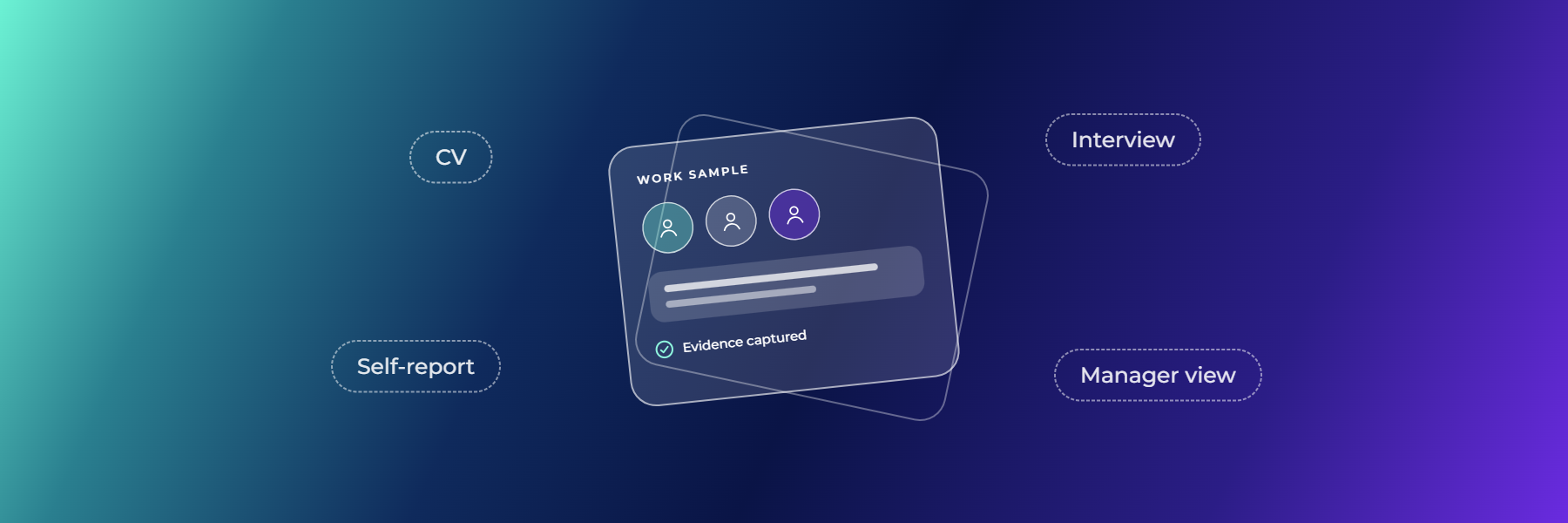
Most consequential people decisions still rest on four sources of evidence, none of which are fundamentally task-based. They do not directly measure what someone can actually do.
CVs describe history, not capability. Interviews reward articulation and preparation, measuring who presents best rather than who performs best. Self-report questionnaires ask people to rate themselves, and candidates may manage their impression to fit the role. Managerial judgements of performance are highly subjective and anchored in past performance; they surface what's easily visible and lack depth.
The challenge we face now is that Gen AI has made the most gameable of those signals substantially more so. Text and image-based assessments are particularly exposed, because a model can read the question and help a candidate shape their answer well within the time available. Meanwhile, application volumes have risen. The Institute of Student Employers in the UK, for example, reports that early careers vacancies are down by a third while employers receive upwards of 140 applications per role.
This creates pressure from both directions. There are many more candidates to assess, but less trustworthy evidence with which to assess them. Over 70% of CEOs name talent as a critical risk to delivering their strategy. Yet while every other function runs on data, the one that determines whether the rest can actually execute is often running on inference.
The way out of this conundrum is not new science. It has been well established for many years. The challenge is that direct measurement of task performance has always been difficult to deliver at scale.
Back in 1968, Wernimont and Campbell drew a distinction that still shapes our thinking. A sign is an indirect indicator from which you infer performance: a personality score, a stated preference, an account of something someone once did. A sample, by contrast, is a piece of the job itself. Their argument, supported consistently in the sixty years since, is that samples are more relevant and predictive than signs.
Recent meta-analytic work is relevant here. In 2022, Sackett, Zhang, Berry and Lievens showed that decades of assessment validity estimates had been over-corrected, and published revised figures on how well different techniques perform.
Within this context, simulation holds up strongly and adds a significant dimension. In 2017, Sackett, Shewach and Keiser examined seventeen study samples where assessment centre and cognitive ability scores predicted the same criterion for the same people. The predictive accuracy of the assessment centre was more than double that of cognitive ability, a reversal of what the field had long assumed.
There is a second difference that matters now. Signs can be rehearsed and often gamed. Samples are harder to fake, because you have to actually do the task.
If work simulation gives such relevant and strong evidence, what has been holding us back all these years?
Primarily cost and scalability. A robust traditional assessment centre needs trained role players, trained assessors, a venue and a wash-up session, and every additional exercise adds a role player, an assessor, a room and an hour. So organisations reserve the approach for early careers volume or the top of the succession pipeline. The most comprehensive method in our field is the one fewest candidates ever experience.
That constraint is not only commercial and logistical. You build a more reliable and accurate picture of someone by observing them across more situations, so the measurement model calls for more exercises while the budget permits fewer. Every assessment centre design is a compromise between the two.
Immersive simulation technology gives us the opportunity to remove the marginal cost of each task-based exercise, and free ourselves from that compromise.
At Symulate we have built an immersive simulation platform around this idea. Candidates interact in real time with live personas (a challenging customer, a colleague in need of support, a board of executives) through natural two-way voice and video conversation. They analyse case material, handle stakeholders, and present and defend their recommendations. The methodology works through six steps.
Step 1 - Profile the role, interpreting a job description or a hiring manager's own account into a clear analysis of the skills and behaviours behind success.
Step 2 - Curate the simulation, using your own content or a library organised by role, level and sector.
Step 3 - Deliver the experience, where the candidate works through scenarios that bring the role to life.
Step 4 Review and score, analysing transcripts against defined behavioural indicators, always with human oversight and decision-making.
Step 5 - Report feedback, with personalised interpretation for every candidate, again with human oversight.
Step 6 - Aggregate into talent intelligence across teams and functions.
The review and scoring step is where the credibility of the whole approach rests. Symulate analyses transcripts and other evidence, summarises behavioural evidence and can suggest scores, with the supporting information attached. A human assessor always reviews, confirms, adjusts or overrides. Nothing is released until they do. Every decision creates an auditable trail and clear ownership, ensuring transparency and legislative compliance.
This design is deliberate, and it follows the evidence. The platform's role is kept as narrow as the task allows. It finds and cites evidence for the assessor, but it does not decide.
The principles that govern good assessment (standardisation, reliability, validity and fairness) have been clear for decades and predate AI entirely. Simulations should be judged in the same terms.
The key question is how those principles are best evidenced. Simulations sit within assessment centre methodology, which has its own established measurement science. That matters, because it means simulations shouldn't be judged by metrics designed for questionnaires or cognitive tests.
Standardisation. The key principle here is comparability: a score has to mean the same thing whoever earned it and whenever they sat it. Simulation scores are criterion-referenced, and comparability rests on the same behavioural indicators and scoring anchors being applied to every candidate, so a '4' describes the same standard of performance every time. Just as in a human role play, candidates must meet similar information and similar demands, so differences in score reflect differences in what they did.
Reliability. The principle is that scores are reproducible. Coefficient alpha is the wrong measure, because it assumes static items, and a simulation is one extended experience producing several distinct judgements. The appropriate measure of reliability is inter-rater agreement with expert raters.
Validity. In simulations this starts with strong content validity, measuring samples of the interactions and work in the role itself. This provides the foundation for criterion validity, which is intrinsic to the assessment centre method and measurable over time.
Fairness. The principle is equal treatment and freedom from bias. Minimising subgroup differences in results is a key indicator, alongside ensuring the work sample elements accurately and fairly reflect the tasks the role requires.
Together, these four principles provide the foundation for taking assessment centre methodology into a fully digital, immersive simulation context.
The technologies needed for immersive talent assessment have arrived at the moment we most need them, as candidates put traditional assessment under real pressure. Many employers are looking for responsible innovation at pace, but technology alone will not deliver it. The key to success is a partnership with assessment science that demonstrates the approach is accurate, fair and impactful for organisations.
If you are wrestling with any of this, whether that's high volumes, assessment integrity, scaling internal talent and development pathways, or simply giving candidates an experience that reflects the behaviours that matter in your organisation, this new approach may be a good fit.