
Here is a piece of arithmetic to reflect on for a moment.
As many as 15% of your candidates might be using generative AI to improve their performance on an online assessment or a recorded video interview, despite having been asked not to. That feels containable, but now run it through a hiring funnel. Those candidates score higher, so proportionally more of them get through. By the time you reach offer stage, they can represent 30% or more of the people you hire.
A minority behaviour at the top of the funnel becomes a substantial share of your hires at the bottom. Current estimates of AI use in assessment range from around 8% to 28% of candidates, so for most organisations this is not hypothetical. It is happening now, quietly, and it is invisible in your data because those candidates may look like your strongest applicants.
Having spent much of my career building assessment technology, at Talent Q, then Sova, and now at Symulate, I believe this wave of change is different from the others. Not only because we have the opportunity to expand our toolkit, but because the integrity of traditional approaches is increasingly under pressure.
In this article we unpack what good assessment can look like in this new and emerging world of work.
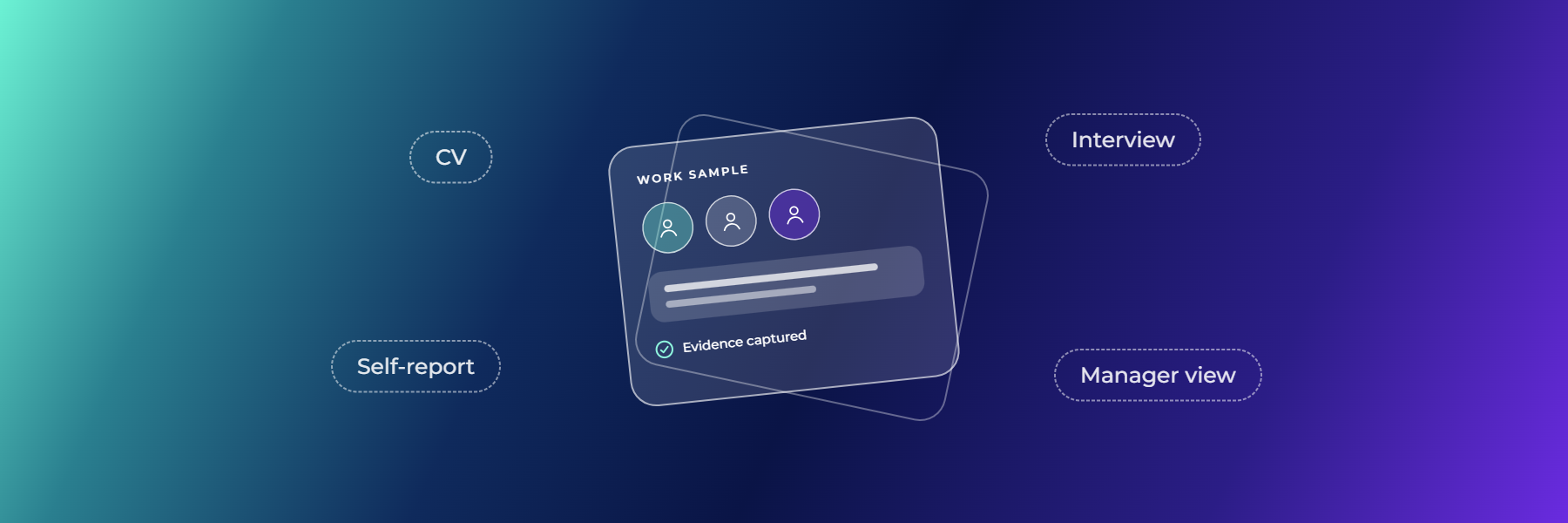
Most consequential people decisions still rest on four sources of evidence, none of which are fundamentally task-based. They do not directly measure what someone can actually do.
CVs describe history, not capability. Interviews reward articulation and preparation, measuring who presents best rather than who performs best. Self-report questionnaires ask people to rate themselves, and candidates may manage their impression to fit the role. Managerial judgements of performance are highly subjective and anchored in past performance; they surface what's easily visible and lack depth.
The challenge we face now is that Gen AI has made the most gameable of those signals substantially more so. Text and image-based assessments are particularly exposed, because a model can read the question and help a candidate shape their answer well within the time available. Meanwhile, application volumes have risen. The Institute of Student Employers in the UK, for example, reports that early careers vacancies are down by a third while employers receive upwards of 140 applications per role.
This creates pressure from both directions. There are many more candidates to assess, but less trustworthy evidence with which to assess them. Over 70% of CEOs name talent as a critical risk to delivering their strategy. Yet while every other function runs on data, the one that determines whether the rest can actually execute is often running on inference.
The way out of this conundrum is not new science. It has been well established for many years. The challenge is that direct measurement of task performance has always been difficult to deliver at scale.
Back in 1968, Wernimont and Campbell drew a distinction that still shapes our thinking. A sign is an indirect indicator from which you infer performance: a personality score, a stated preference, an account of something someone once did. A sample, by contrast, is a piece of the job itself. Their argument, supported consistently in the sixty years since, is that samples are more relevant and predictive than signs.
Recent meta-analytic work is relevant here. In 2022, Sackett, Zhang, Berry and Lievens showed that decades of assessment validity estimates had been over-corrected, and published revised figures on how well different techniques perform.
Within this context, simulation holds up strongly and adds a significant dimension. In 2017, Sackett, Shewach and Keiser examined seventeen study samples where assessment centre and cognitive ability scores predicted the same criterion for the same people. The predictive accuracy of the assessment centre was more than double that of cognitive ability, a reversal of what the field had long assumed.
There is a second difference that matters now. Signs can be rehearsed and often gamed. Samples are harder to fake, because you have to actually do the task.
If work simulation gives such relevant and strong evidence, what has been holding us back all these years?
Primarily cost and scalability. A robust traditional assessment centre needs trained role players, trained assessors, a venue and a wash-up session, and every additional exercise adds a role player, an assessor, a room and an hour. So organisations reserve the approach for early careers volume or the top of the succession pipeline. The most comprehensive method in our field is the one fewest candidates ever experience.
That constraint is not only commercial and logistical. You build a more reliable and accurate picture of someone by observing them across more situations, so the measurement model calls for more exercises while the budget permits fewer. Every assessment centre design is a compromise between the two.
Immersive simulation technology gives us the opportunity to remove the marginal cost of each task-based exercise, and free ourselves from that compromise.
At Symulate we have built an immersive simulation platform around this idea. Candidates interact in real time with live personas (a challenging customer, a colleague in need of support, a board of executives) through natural two-way voice and video conversation. They analyse case material, handle stakeholders, and present and defend their recommendations. The methodology works through six steps.
Step 1 - Profile the role, interpreting a job description or a hiring manager's own account into a clear analysis of the skills and behaviours behind success.
Step 2 - Curate the simulation, using your own content or a library organised by role, level and sector.
Step 3 - Deliver the experience, where the candidate works through scenarios that bring the role to life.
Step 4 Review and score, analysing transcripts against defined behavioural indicators, always with human oversight and decision-making.
Step 5 - Report feedback, with personalised interpretation for every candidate, again with human oversight.
Step 6 - Aggregate into talent intelligence across teams and functions.
The review and scoring step is where the credibility of the whole approach rests. Symulate analyses transcripts and other evidence, summarises behavioural evidence and can suggest scores, with the supporting information attached. A human assessor always reviews, confirms, adjusts or overrides. Nothing is released until they do. Every decision creates an auditable trail and clear ownership, ensuring transparency and legislative compliance.
This design is deliberate, and it follows the evidence. The platform's role is kept as narrow as the task allows. It finds and cites evidence for the assessor, but it does not decide.
The principles that govern good assessment (standardisation, reliability, validity and fairness) have been clear for decades and predate AI entirely. Simulations should be judged in the same terms.
The key question is how those principles are best evidenced. Simulations sit within assessment centre methodology, which has its own established measurement science. That matters, because it means simulations shouldn't be judged by metrics designed for questionnaires or cognitive tests.
Standardisation. The key principle here is comparability: a score has to mean the same thing whoever earned it and whenever they sat it. Simulation scores are criterion-referenced, and comparability rests on the same behavioural indicators and scoring anchors being applied to every candidate, so a '4' describes the same standard of performance every time. Just as in a human role play, candidates must meet similar information and similar demands, so differences in score reflect differences in what they did.
Reliability. The principle is that scores are reproducible. Coefficient alpha is the wrong measure, because it assumes static items, and a simulation is one extended experience producing several distinct judgements. The appropriate measure of reliability is inter-rater agreement with expert raters.
Validity. In simulations this starts with strong content validity, measuring samples of the interactions and work in the role itself. This provides the foundation for criterion validity, which is intrinsic to the assessment centre method and measurable over time.
Fairness. The principle is equal treatment and freedom from bias. Minimising subgroup differences in results is a key indicator, alongside ensuring the work sample elements accurately and fairly reflect the tasks the role requires.
Together, these four principles provide the foundation for taking assessment centre methodology into a fully digital, immersive simulation context.
The technologies needed for immersive talent assessment have arrived at the moment we most need them, as candidates put traditional assessment under real pressure. Many employers are looking for responsible innovation at pace, but technology alone will not deliver it. The key to success is a partnership with assessment science that demonstrates the approach is accurate, fair and impactful for organisations.
If you are wrestling with any of this, whether that's high volumes, assessment integrity, scaling internal talent and development pathways, or simply giving candidates an experience that reflects the behaviours that matter in your organisation, this new approach may be a good fit.